Dining-out prices keep outpacing at-home food inflation. Cooking even three nights a week flips the monthly math in your favor.
The Macro Trend (Official Numbers)
The data doesn’t lie—eating out is taking a bigger bite of our budgets every year.
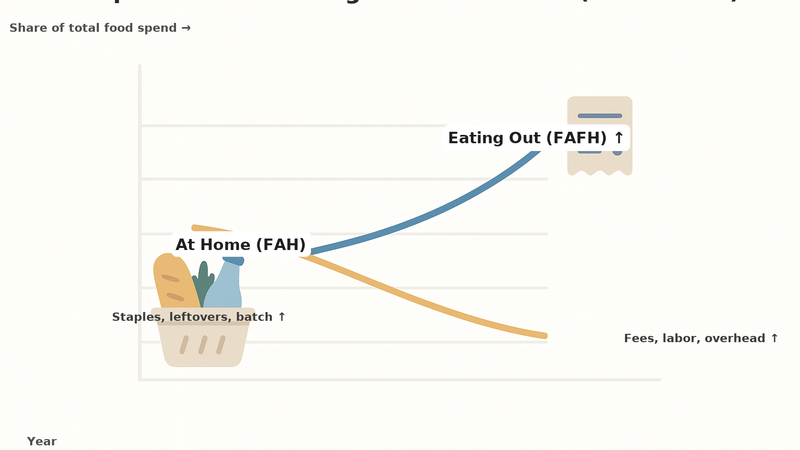
Food-away-from-home share at a series high: 2024 FAFH (food away from home) reached 58.9% of total U.S. food spending, according to USDA Economic Research Service data. That means Americans now spend more on restaurant meals than groceries for the first time in modern history.
Spending growth led by eating out: The USDA’s Food Expenditure Series shows recent growth primarily on the FAFH side. While grocery prices have stabilized somewhat, restaurant prices continue their relentless climb.
Context on recent years: Per-capita FAH (food at home) spending softened in 2022–2023 while FAFH kept rising. The gap is widening, and it’s costing families thousands of dollars per year.
Why Restaurant Prices Keep Rising
Understanding the economics helps explain why this trend will likely continue:
- Labor costs: Restaurant workers’ wages are rising (as they should), and labor typically represents 30-35% of restaurant costs
- Commercial rent: Prime locations cost more than ever
- Food waste: Restaurants must account for spoilage and waste in their pricing
- Profit margins: Restaurants need 10-15% profit margins to survive
- The convenience tax: You’re paying for service, ambiance, and not having to clean up
None of these factors are going away. If anything, they’re accelerating.
A Simple Monthly Budget Example
Let’s break down what this actually means for your wallet:
| Scenario | Dinners out / week | Est. dinner cost | Monthly total |
|---|---|---|---|
| Heavy eating out | 5 | €14 | ~€280 |
| Balanced | 2 out / 5 home | €14 out / €2.20 home | ~€140 |
| Mostly home | 1 out / 6 home | €14 out / €2.20 home | ~€88 |
The difference between “heavy” and “mostly home”? €192 per month, or €2,304 per year.
That’s:
- A vacation for two
- Six months of a gym membership
- Your emergency fund
- Retirement contributions that compound for decades
The Hidden Multiplier Effect
But wait—there’s more (and it’s not good news for your wallet):
When you eat out frequently, you also tend to:
- Buy groceries that go bad (waste: ~$100/month)
- Order delivery more often (add delivery fees + tips)
- Impulse-order appetizers and drinks
- Spend more on breakfast/lunch the next day
The official €280/month estimate is conservative. For many households, the real cost is closer to €400-500/month.
Three High-Impact Moves
You don’t need to become a hermit chef. Here’s how to flip the math with minimal friction:
1. Plan three dinners
Pick two 20-minute recipes and one leftovers night. That’s it. You’ve just cut your restaurant spending by 40-50%.
2. Shop once, cook twice
Double your rice. Make a big pot. One becomes dinner, one becomes lunch tomorrow. Time efficiency: 2x. Cost efficiency: 2x.
3. Swap one premium ingredient
- Steak → chicken thighs or beans
- Jar sauce → 5-minute pan sauce (garlic, olive oil, pasta water)
- Expensive fish → canned sardines or tinned salmon
You maintain flavor, slash costs, and often improve nutrition.
The 2025 Reality Check
Here’s the uncomfortable truth: eating out used to be an occasional treat. For many households, it’s become the default.
The USDA data shows we’ve crossed a tipping point—58.9% of food spending is now restaurants and takeout. Our grandparents would be shocked.
The question isn’t: “Should I ever eat out?”
The question is: “What’s the right balance for my budget and health?”
Making the Shift Stick
Knowing you should cook more is easy. Actually doing it is hard. Here’s the psychology:
The problem: Decision fatigue. By 6 PM, you’re exhausted and “What’s for dinner?” becomes “Let’s just order.”
The solution: Decide on Sunday what you’ll cook Monday-Wednesday. Remove the daily decision. Pre-decide = pre-succeed.
The tracking: Log your “home dinners” count. Seeing “12 home dinners this month” become “18 home dinners this month” is addictive. Progress is motivating.
Your 30-Day Challenge
For the next month:
- Track every food dollar (apps make this dead simple)
- Cook 3 dinners per week at home
- Compare your March spend to February spend
- Invest the difference (literally move it to savings)
Expected results: €80-150 saved in one month. Multiply by 12 months. You’re looking at €960-1,800 per year—just from cooking 3 more dinners per week.
The Bottom Line
The macro trend is clear: eating out is getting more expensive, and the gap is widening.
You can’t control restaurant prices. You can’t change USDA data. You can’t reverse inflation.
But you can control what you cook Tuesday night. And that changes everything.
Lock a Monthly Cap and See Your Savings
Try Budget Mode · Download on iOS · Get it on Google Play
Sources & References
- USDA Economic Research Service: Food Expenditure Series
- USDA ERS: Chart Gallery - Food away from home share
- USDA ERS: Charts of Note - Recent food spending trends
- American Institute for Cancer Research: Study: Healthy foods prepared at home save money and boost diet quality
- Harvard Health: Home cooking good for your health